
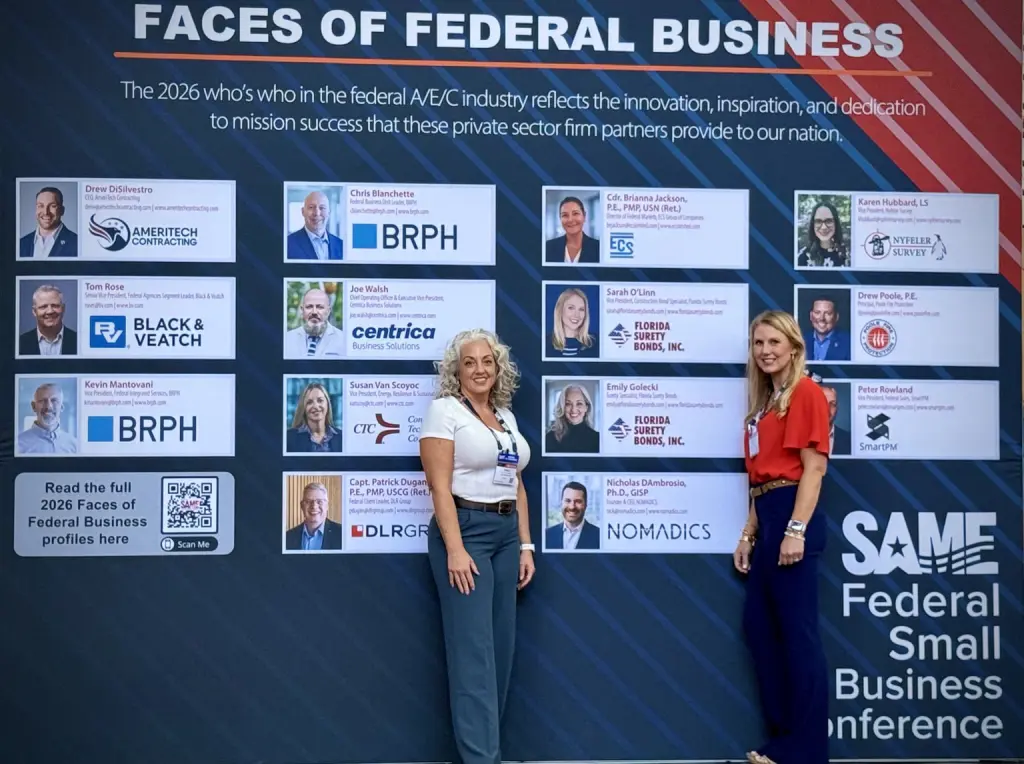
By Sarah O’Linn | Florida Surety Bonds | Nov 12th, 2026
Debrief of 2026 Society of American Military Engineers (SAME) Small Business Conference (SBC) in Charlotte, NC
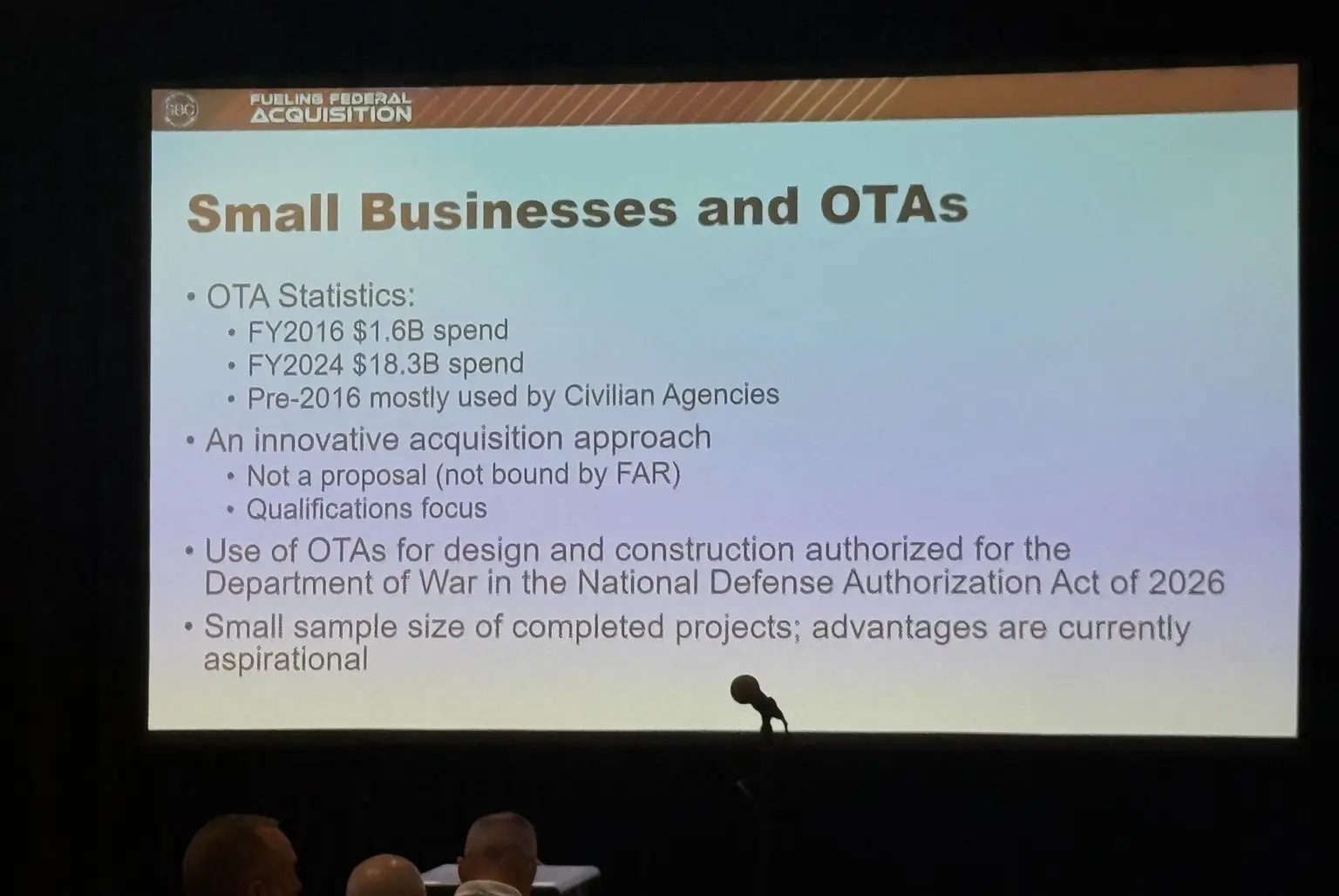
A year ago, if you asked a room full of federal contractors what an OTA was, you got a lot of blank stares. Last week at the Society of American Military Engineers (SAME) Federal Small Business Conference, known as SBC, OTAs were the topic in almost every session I sat in.
I heard it from the U.S. Army Corps of Engineers (USACE) leadership panel, from the small business coalition meetings, from the attorneys, and in plenty of hallway conversations at the booths. The big takeaway: OTAs are no longer just a niche, innovative research and development (R&D) contracting tool for mega projects. They are becoming a mainstream way the military buys construction, and they are moving fast.
Here is what you need to know, what the agencies are publishing, and, since I am a surety agent, what it means for your bonding.
What is an OTA, in plain English?
OTA stands for Other Transaction Authority. It lets a federal agency sign an “other transaction” agreement instead of a traditional contract under the Federal Acquisition Regulation (FAR), the rulebook that governs most federal buying.
The military has used OTAs for years on research and prototypes. What changed is the Fiscal Year 2026 National Defense Authorization Act (NDAA), signed in December 2025. It created a new law, 10 U.S.C. Section 2808a, that lets the Department of War (formerly the Department of Defense) use OTAs to plan, design, build and repair facilities, with no dollar cap in the statute itself.
In practice, an OTA lets the government buy construction more like a private owner does:
- Qualifications-based selection. The team is picked mostly on experience, approach and people, not the lowest bid.
- Negotiated, “open book” pricing. The price is worked out together as the design develops, with costs visible to both sides.
- Collaborative delivery. The main methods are progressive design-build (PDB), where the builder and designer are hired early and the price is set once the design is far enough along; design-build to a fixed budget; and construction manager at risk (CMAR).
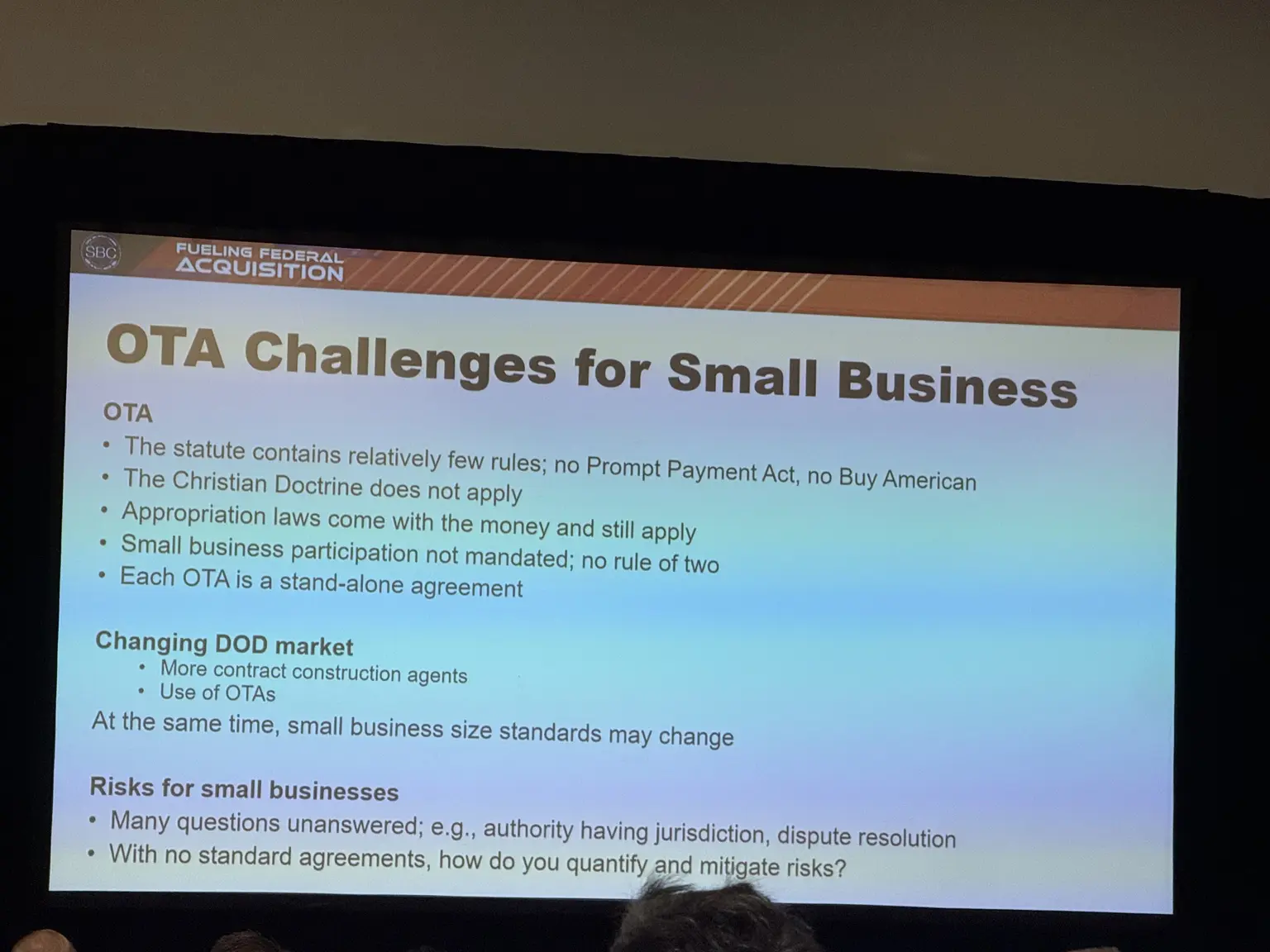
The tradeoff is that the familiar FAR clauses do not automatically come along. As one federal attorney told me, treat an OTA like a commercial contract: if a term is not written inside the four corners of the agreement, do not assume it is there.
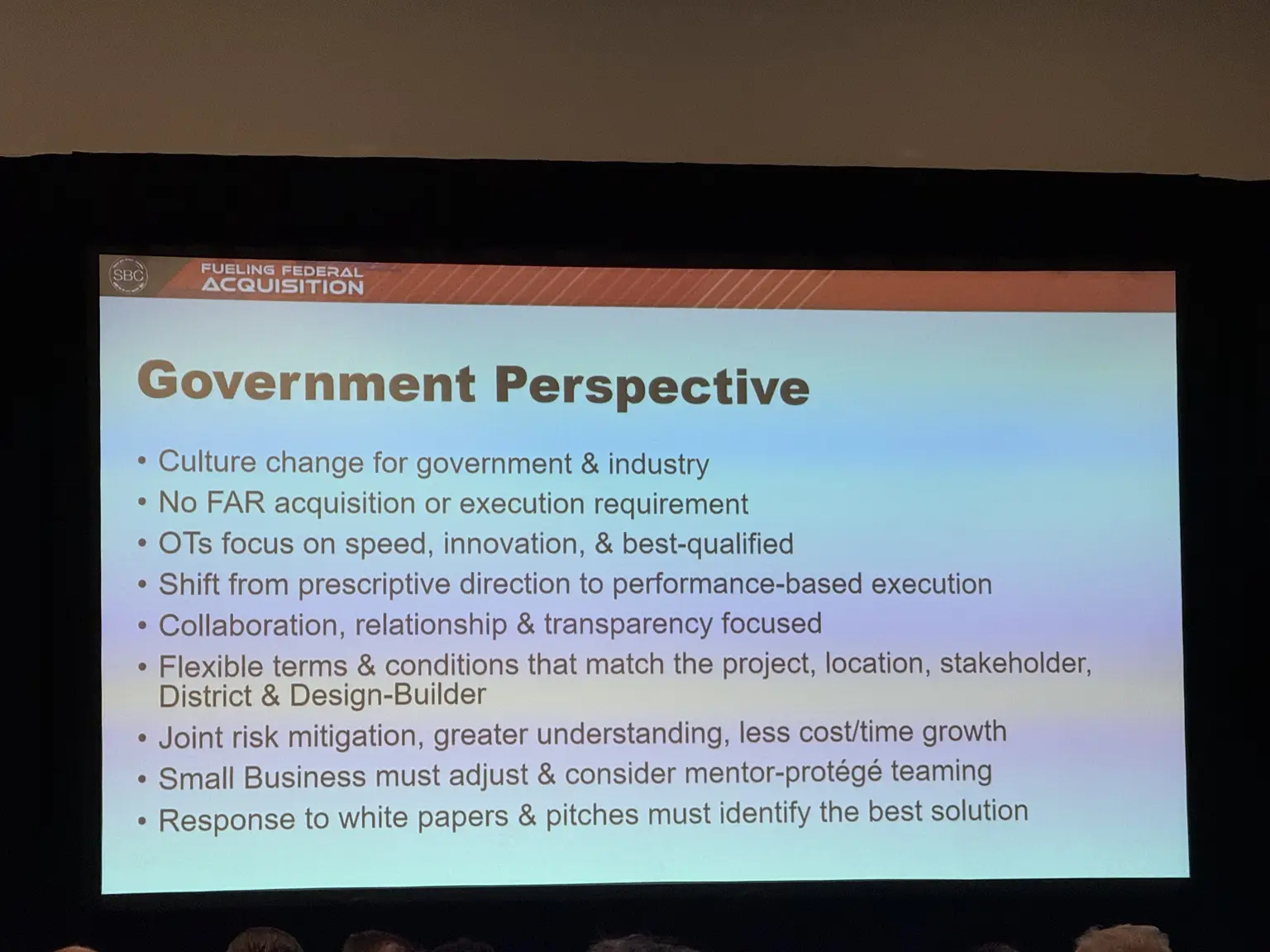
What We Learned at SBC
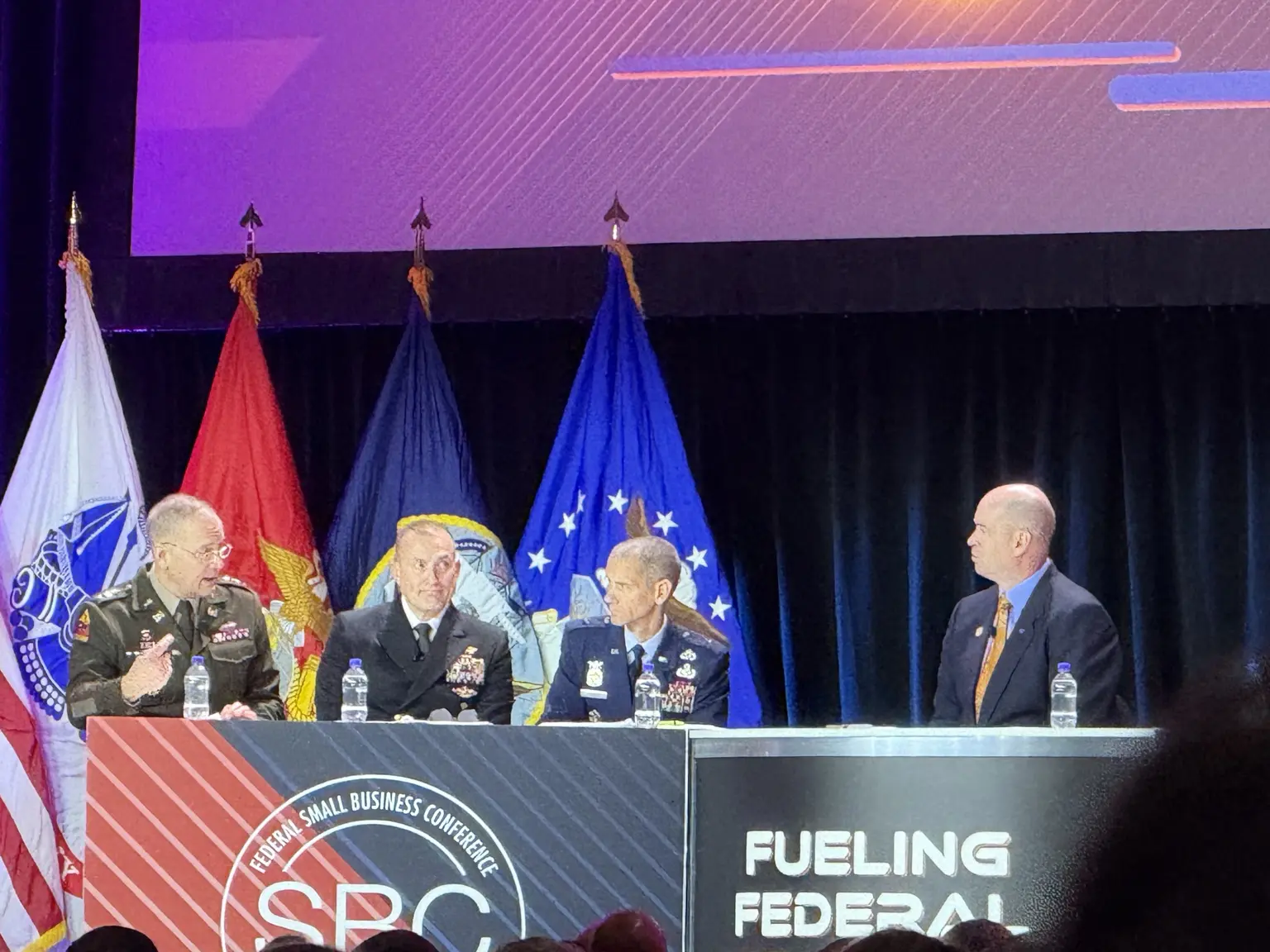
SAME SBC Army Mega Session Panel
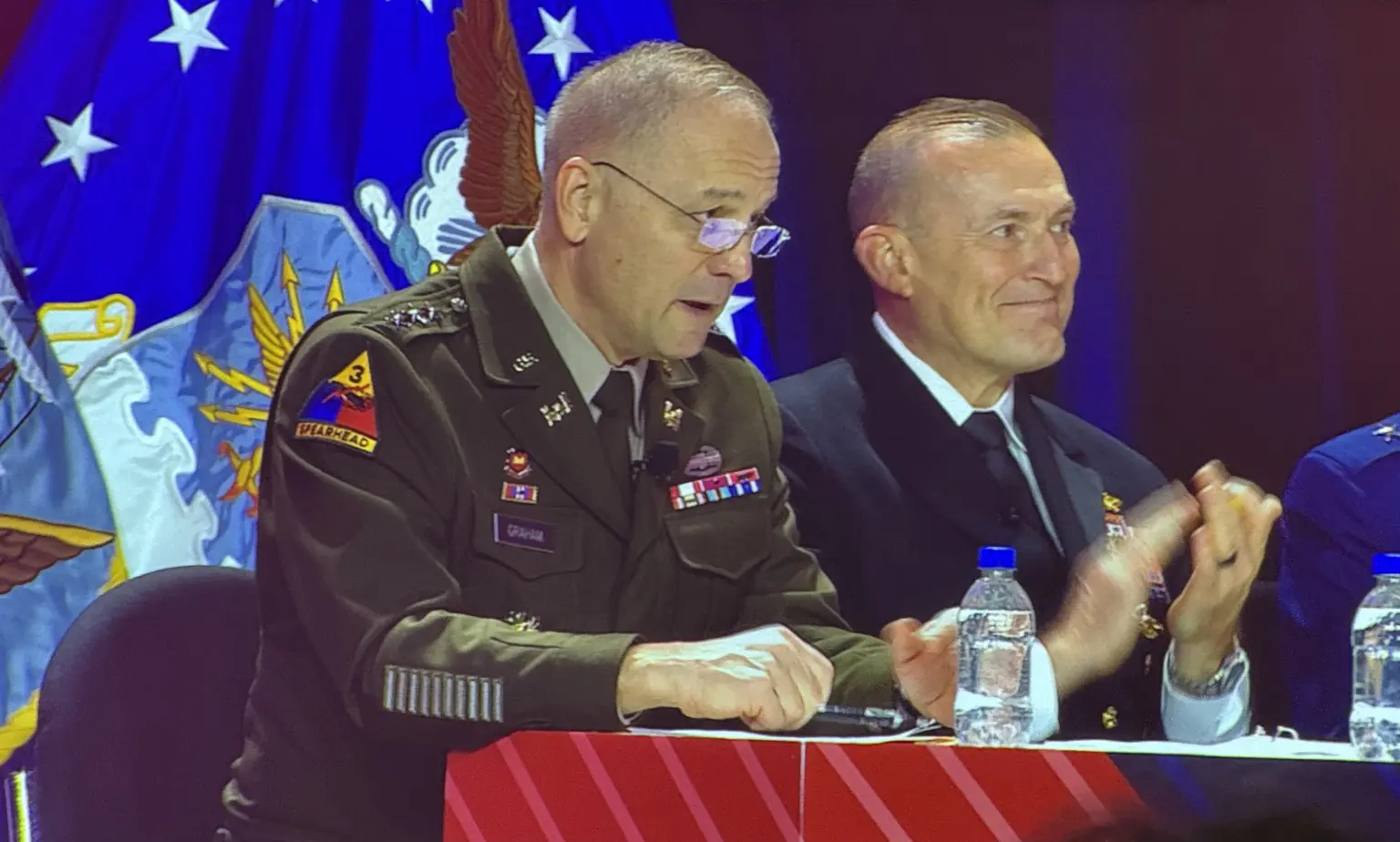
USACE was the most specific about where this is headed: in about a year it has grown from 4 to more than 180 agreements officers (the officials who sign OTAs), it expects to go from about 15 active construction OTAs to nearly 200 by the end of 2027, and Lieutenant General William “Butch” Graham, Chief Engineer and Commanding General of the U.S. Army Corps of Engineers, shared his goal for USACE facilities to be delivered 50% faster and 30% cheaper.
A few other themes came up again and again:
- Small business is still figuring out its place. Unlike FAR contracts, OTAs do not automatically carry small business set-asides. Most current USACE OTAs are $40 to $50 million and up. USACE said it is looking at smaller OTAs for installation repair work and looking for feedback to help mode the next OTA Playbook small business guidance.
- Teaming is the new business development. With the general contractor typically leading a progressive design-build team, many designers and specialty firms will win this work as team members rather than as primes. Building relationships within in the federal space is more important than its ever been.
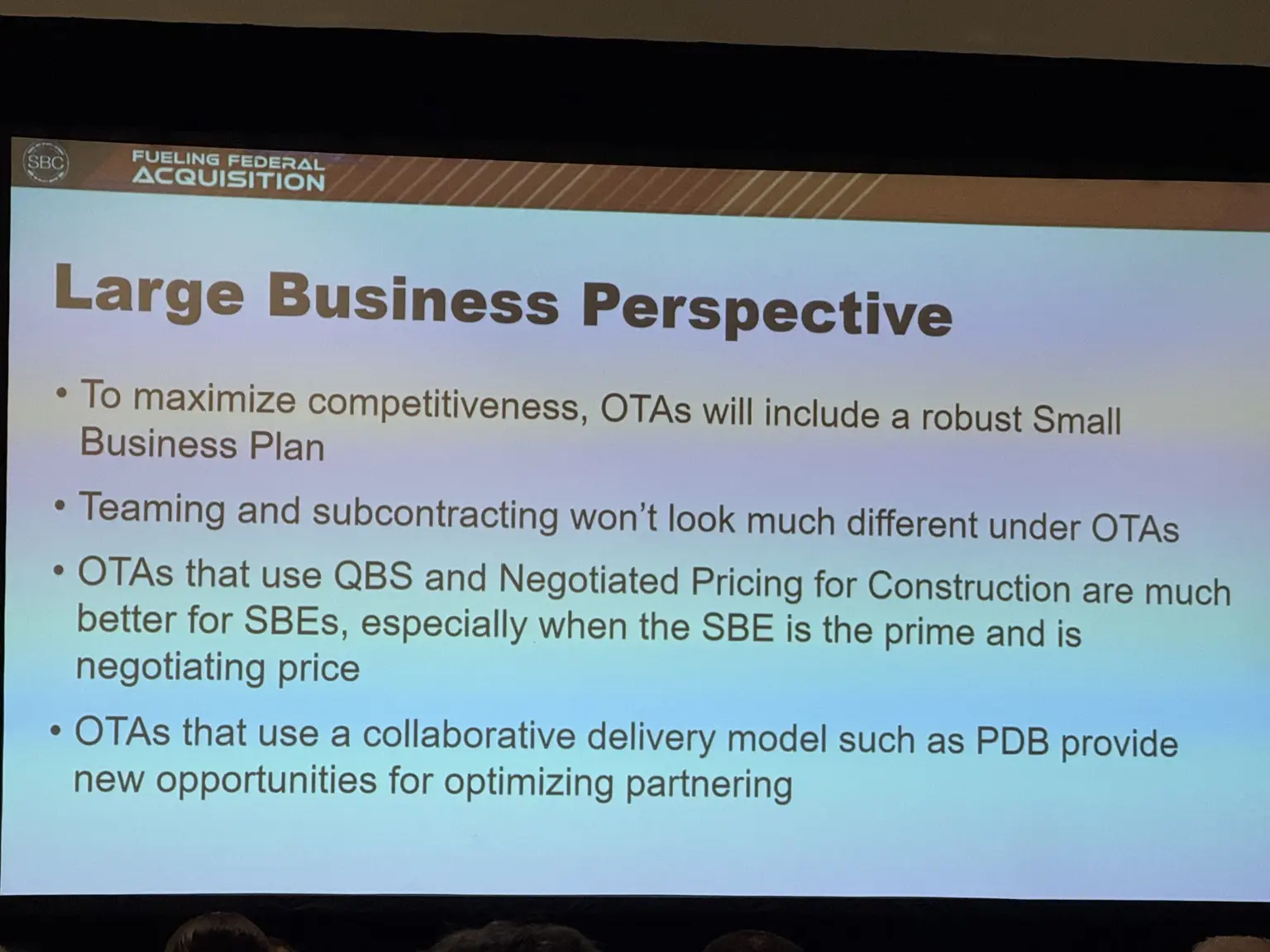
- Government Contracting Officers are facing steep learning curve too. Several speakers noted that even agencies with deep construction experience are adjusting to a significant culture shift as they adopt Other Transaction Authority (OTA) and progressive design-build. These models work best when the government owner and the contractor decision makers collaborate closely and make decisions in real time, which is essential when the scope can’t be fully defined upfront.
- A resource for Government Contracting Leaders: The Florida Dept of Transportation (FDOT) offers a proven model to borrow from. FDOT’s progressive design-build playbook has been refined through demanding infrastructure programs and natural disasters, including Hurricane Ian. After Ian destroyed the Sanibel Causeway in 2022, FDOT and a joint venture of Jacksonville-based Superior Construction and the de Moya Group used an emergency progressive design-build approach to restore emergency access within a week and complete the rebuild two years ahead of schedule. FDOT’s lessons translate directly to federal agencies for how to assign project decision makers and share risk of on-site conditions, utilities, and permitting before locking in a guaranteed maximum price.
- For traditional contracts, the FDOT voluntary acceleration incentives may be a good spec for Federal agencies to incorporate into contracts. The Voluntary Acceleration specs reward Contractors who complete projects early and has shortened FDOT project schedules by 20 to 30 percent. They are desirable to Contractors and fairly simple for Gov to administer with minimal learning curve. Government agencies can find the Voluntary Acceleration specs in FDOT Spec Revision SS0040310 here.
- Contractors and Engineers may already be looking at OTAs and not know it. The solicitation may lead with “progressive design-build” and mention Other Transactions (OT) or similar terms more subtly.
- Where can you find construction-related OTAs? They are still being posted on SAM.gov like everything else.
- Less of a September rush. NAVFAC’s chief engineer said a new FY2026 NDAA authority lets them carry some one-year operations and maintenance funds past September 30, so contracts do not have to be awarded before they are ready. He also described accelerated design-build, which lets design start up to a year earlier using design funds, and a repair-by-replacement authority the Marine Corps plans to use for about 30,000 barracks rooms.
The Agency OTA Playbooks
Each service is rolling out OTAs a little differently. Here is where things stand as of this week.
USACE. USACE is the Army’s construction agent, and it has the most complete public guidance. Its USACE OTA Playbook: Executing Progressive Design-Build with Other Transaction Authority (Version 1.0, June 2026) is a great resource that lays out a recommended process that can be tailored to each project. A revised version with the latest lessons learned is expected in the next few weeks.
Notably missing from the 1st OTA playbook is surety bond guidance, so Emily Golecki had the opportunity at SAME SBC to ask the USACE Mega Session leadership whether the revision will include guidance for contracting officers on bond requirements, since the FAR does not apply to OTAs and the latest OTA Playbook did not yet reference any bond requirements. Performance and payment bonds ensure the timely performance of federal construction contracts, as well as, the payment of subcontractors and suppliers. Performance and payment bonds boost the Department of War’s mission to expedite project completion. A 2022 Ernst and Young study found that 5 times more project owners reported bonded projects finish ahead of schedule or on time when compared to unbonded projects. In the event of a project default, unbonded projects take nearly twice as long to complete as bonded projects. Contractors facing financial distress place a higher priority on finishing bonded projects, nearly 5 times more often than unbonded projects.
So far, we’ve been issuing Performance and Payment (P&P) bonds for OTA awards with no issue. We often provide subject matter expert (SME) guidance to Contracting Officers looking for best ways to tailor the bond requirements for their unique project needs, funding limits, deadlines and risk tolerance. We understand the need for speed and reducing paperwork per General William “Butch” Graham, and we’re happy to provide examples and explain how to tailor the familiar FAR bond requirements to OTAs, task orders and other contract vehicles.
According to USACE playbook, there are often two “off-ramps,” around 35% design and at the price negotiation, where USACE can walk away and keep the design.
The playbook also notes that small business requirements do not apply the way they do under the FAR which is a concern to many small businesses. USACE leadership hopes to address this in the next iteration of their OTA playbook with their leadership in information gathering mode at the SAME SBC to help them provide better guidance for this in next iteration. USACE also said a Design-Build-to-Budget Playbook is due by December 31, with a Construction Manager at Risk (CMAR) Playbook after that, which is welcome news.
Air Force. The Air Force has not published its own OTA construction playbook that I’m aware of, and at its SBC Mega Session, leaders pointed industry to the USACE playbook referenced above. What has changed is who runs the work. The FY2026 NDAA ended the requirement that USACE or NAVFAC manage military construction, so the Air Force can now act as its own design and construction agent. It is doing that on big projects like the U.S. Space Command headquarters at Redstone Arsenal, where the Air Force Civil Engineer Center (AFCEC) is bringing on an “owner’s advisor” to help manage a progressive design-build OTA. Another is the Medical Education and Training Campus, where five dormitories for about 6,000 trainees are planned to be finished within 24 months of groundbreaking.
The Air Force called itself “all in” for 2027. Teams now need a waiver to skip the new authorities, and projects above a set dollar threshold default to OTA-type delivery. Attendees heard that threshold is $7.5 million, so its not just mega projects. Below the threshold, the choice is case by case, and the Air Force cautioned not to assume every design-build solicitation is an OTA. Trained staff are still scarce: about 280 Air Force contracting professionals have OTA training, with another 265 just starting coursework.
Navy and NAVFAC. NAVFAC has not published an OTA playbook either, and its commander was candid that NAVFAC is moving deliberately on OTAs, especially given their full plate with reorganization. Even so, NAVFAC already has about $7 billion in OTAs underway, mostly factory-built (“industrialized”) barracks for the Marine Corps. Its Camp Pendleton barracks OTA uses progressive design-build and targets schedules at least 30% faster and costs at least 20% lower.
NAVFAC is also developing a new Portfolio Acquisition Executive (PAE) for Shore Infrastructure, which will issue most future construction contracts. Existing contracts will run through their expiration. NAVFAC said it met all five of its small business goals this year and is still setting work aside, and solicitations will still be posted on SAM.gov.
What These Changes Mean for Bonding and Sureties
Yes, bonds are still required on OTAs with construction scope . OTAs skip the FAR, which is a set of regulations with clear bond requirements. The OTAs do not skip federal statutes. The Miller Act, the law requiring performance and payment bonds on federal construction, still applies. USACE leadership confirmed this on stage and said they will provide further guidance on exactly how they apply in next playbook. Performance and payment bonds ensure the timely performance of federal construction contracts, as well as, the payment of subcontractors and suppliers.
The Miller Act Performance and payment bonds continue to boost the Department of War’s mission to accelerate acquisition and construction; so much so, that some might argue its why the Department of War chose BOND as the acronym for their Business Operators for National Defense (BOND) acquisition acceleration operation.
Surety Carrier Claim departments who fail to perform their bond obligations are on notice by the Dept of War. In the statistically rare cases that the Dept of War believes a Surety’s claims dept is not honoring the bond obligations, Federal Agencies can take action by filing complaint with Treasury’s Surety Bonds division and can pursue their removal from Treasury Listing outlined below.
Treasury Surety Complaint Process: https://fiscal.treasury.gov/about-us/doing-business-with-fiscal-service/surety-bonds/complaint-procedure
To Request Surety’s Removal from Treasury / Revocation of Certificate of Authority, see 31 C.F.R. 223.20
Bonding capacity is now a qualification, not just a formality. For USACE, you typically will not post the performance and payment bonds until the construction phase. But agencies want proof up front that you can get them, often as part of the qualifications package. Hopefully the next iteration of OTA playbooks will clarify whether that proof should be a bonding prequalification letter signed by your surety agent, a bid bond, or bond program limits self-reported by the contractor.
Long selections and phased design work could tie up capacity. Selection and design can stretch for months before construction starts, although this is nothing new for federal contractors. USACE’s director of contracting said USACE, and NAVFAC as well, are working with sureties on ways to phase bonding so it does not lock up all of your capacity at once. In the meantime, timely work-in-progress (WIP) schedule updates and a good relationship with a federal-savvy surety agent will keep that capacity working for you.
Watch the size of bundled packages. Increased consolidation of projects into larger packages. The Air Force is weighing packages as large as 11 facilities under one award on programs like the F-47, and openly asked industry whether these are getting too big. This is a major concern for small and medium sized businesses who are more than capable of successfully performing the work but their financials and single project bonding limits may not support the jump in contract size at one time..yet. This significantly limits the competition. Bigger packages mean bigger single-project bonds, so know your limits before you team. If great opportunity comes up that is a jump in jobsize, share with your surety agent early why its a good fit for your experience and balance sheet so they can go to bat for you to get the surety credit you need.
The Bottom Line
OTAs went from a mystery to a mainstream tool in less than year, and the playbooks are still being written. The agencies were open about that at SBC. They called these living documents and asked industry for feedback, so expect changes over the next 12 months.
For federal construction contractors, the opportunity is real: earlier involvement, more collaboration, and selection based on what you do well, not just your price. The risk is real too, because the FAR protections you are used to only exist if they are written into the agreement.
At Florida Surety Bonds, we work with federal contractors on exactly these questions every day. If you are looking for at an OTA, or are not sure whether the progressive design-build opportunity you are chasing is one, give us a call. We are happy to walk through your bonding program before you commit resources.
Florida Surety Bonds is licensed in all 50 states and has former federal acquisition and source selection evaluation lead experience and deep surety experience on our team to advise you.
Disclaimer: I am not an attorney, and this post is not legal advice. It is general information and insights gathered from public sources and the informative 2026 SAME SBC sessions and discussions held in Charlotte, NC in Nov 2026.
Author: Sarah O’Linn, Construction Surety Agent & Managing Partner at Florida Surety Bonds and former NAVAIR Lead Systems Engineer & Source Selection Evaluation Lead [email protected] | 407-755-6353 | Licensed in all 50 states
Sources
- USACE PDB with OTA Playbook, v1.0 (June 12, 2026)
- Holland & Knight, The New OTA Authority for Military Construction (July 23, 2026)
- NAVFAC, Camp Pendleton barracks OTA release (Sept. 1, 2026)
- AFCEC, U.S. Space Command C2F Owner’s Advisor notice (SAM.gov)
- U.S. Treasury, Bureau of the Fiscal Service, Surety Bonds: Complaint Procedure
- 31 C.F.R. § 223.20, Revocation proceedings initiated by Treasury upon receipt of an agency complaint (eCFR)